Jan 30, 2026
Articles
Jan 30, 2026
Articles
Jan 30, 2026
Articles
The Three Compliance Use Cases Where LLMs Actually Work (And Why Everything Else Fails)

Martín Ramírez
Martín Ramírez
Martín Ramírez
I watched an LLM evaluate a food formula for GRAS compliance and confidently identify a chemical with a completely fabricated CAS number.
The number looked legitimate. The format was correct. The response was authoritative.
When I looked it up to confirm, I discovered it didn't exist.
My immediate thought: "If it did this, what else is it making up?"
That moment collapsed my trust in AI for compliance work. But it also forced me to ask a better question: not whether LLMs can handle compliance tasks, but which specific compliance problems they can solve without introducing unacceptable risk.
After building evaluation frameworks across our entire pipeline and watching hundreds of implementations, I've identified exactly three use cases where LLMs genuinely reduce compliance risk. Everything else either fails quietly or creates new problems you don't discover until after deployment.
Why Most Compliance Use Cases Fail: The 30% Gap
Here's what the benchmarks won't tell you.
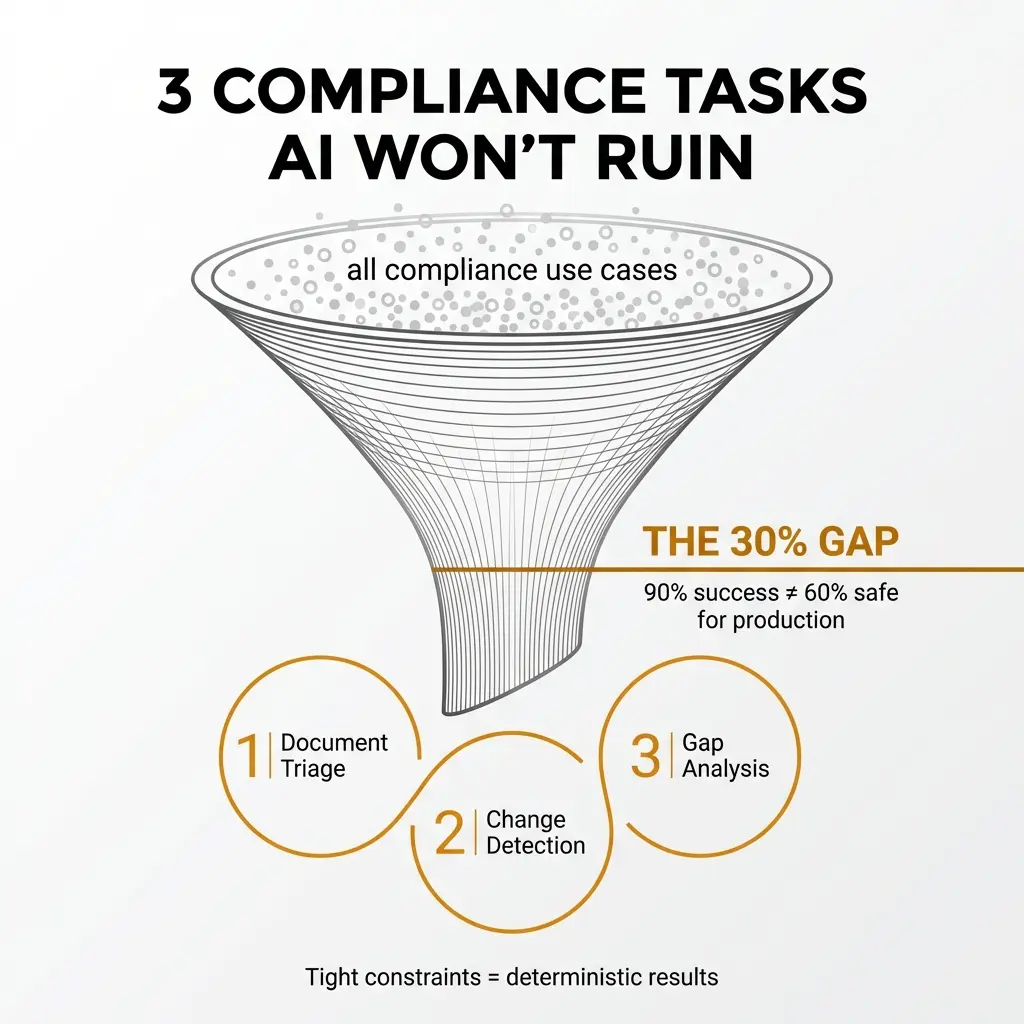
If your AI agent has a 90% success rate, only about 60% of those "successes" are actually safe for production. The remaining 30% represent policy violations.
Traditional benchmarks ask: "Did the agent complete the task?"
The question that actually matters: "Did the agent complete the task without violating critical enterprise policies?"
This gap explains why 95% of AI efforts fail when organizations spend too little time defining what they want the system to do and how they'll measure it. The failure isn't technical. It's conceptual.
The biggest misconception I encounter: compliance officers believe AI will declare their product compliant.
That's not what it does.
AI performs sophisticated pre-checks and helps discover gaps that would make products noncompliant. That difference is everything.
The Three Use Cases That Actually Work
These succeed because they share a critical characteristic: they operate within constraints tight enough to make the LLM's knowledge universe deterministic.
1. Document Triage at Scale
The volume problem crushes compliance teams. Manual regulatory work is time-consuming and error-prone, while traditional rule-based monitoring systems generate false positive rates between 90-95%. Your team drowns in alerts that aren't actual issues.
LLMs solve this specific problem.
Controlled studies demonstrate a 76.3% reduction in compliance assessment time compared to manual reviews, while improving compliance coverage by 23.8 percentage points.
Machine learning models can cut false positives by 60%, with that number expected to rise as models continue to learn. AI-powered systems have reduced compliance workload dramatically, allowing teams to focus on genuine risk rather than false alerts.
But here's why this works when other use cases don't: document triage is a filtering problem, not a judgment problem.
You're asking the LLM to identify potential issues, not declare conformance. The human expert still makes the final call. The AI just removes the tedious work of manually searching and cross-referencing across thousands of SKUs and documentation before subject matter experts deploy judgment.
2. Regulatory Change Detection Across Jurisdictions
Product compliance requirements have become significantly more complex over the past three years, with 85% of compliance professionals reporting increased complexity across jurisdictions.
For CPG brands selling across multiple markets—whether different states with varying supplement regulations or international markets with different cosmetic ingredient restrictions—the multi-jurisdiction challenge is fundamentally a monitoring problem at scale that humans can't solve.
AI monitoring operates around the clock, processing thousands of regulatory sources simultaneously. Unlike traditional approaches that depend on compliance teams periodically checking government websites or subscribing to legal newsletters, AI operates continuously.
Nine out of 10 companies plan to adopt continuous compliance within the next five years.
This use case succeeds for the same reason document triage works: you're not asking the LLM to interpret ambiguous regulations. You're asking it to detect when something changed.
The system flags new regulations, amendments, or enforcement actions. Your compliance team still interprets what those changes mean for your business. The AI shortens the path to expert judgment.
3. First-Pass Gap Analysis
Take a food label review that must determine conformance with 21 CFR Part 101 here in the US, or a cosmetic ingredient evaluation against EU regulations.
For product compliance, you have access to the regulatory corpus (FDA regulations, EU cosmetics directives, dietary supplement guidelines), warning letters issued against brands with labeling or formulation errors, and relatively clear interpretations of requirements. This makes label evaluation and ingredient compliance checks with a properly constrained LLM near-deterministic.
Benchmark testing shows this approach achieves 92.8% precision and 94.1% recall in identifying actionable compliance requirements, outperforming previous solutions by 18.7 percentage points.
Advanced frameworks demonstrate 99.2% recall with only a 4.4% false positive rate on large models, while baseline approaches struggle with complex logic and generate 52.2% false positive rates.
But here's what makes a constraint "right" versus inadequate.
The regulation has clear consensus in the industry. The interpretation is deterministic. The enforcer is consistent. You have access to abundant examples the LLM can examine to establish what conforms versus what doesn't.
When those conditions break down, everything changes.
When LLMs Shift from Evaluator to Scenario Tool
What I tell customers: if there isn't clear consensus in the industry, if the regulation remains open to interpretation and debate, if the enforcer is inconsistent, if your company sees regulations as the floor or ceiling for quality and safety, if you have limited access to examples, the problem becomes murkier.
The LLM will still do a good job collating the conflicting information.
But now you need different tactics to ground its inferences. How you present results becomes critical. You don't want to present the LLM's response as the mediator or arbitrator of truth. You need to make it malleable enough to allow the subject matter expert to run what-if scenarios with the LLM.
For example: What if the FDA is more lenient on this claim versus not? What if my company just issued a recall for a similar ingredient issue? What if this cosmetic ingredient is approved in the EU but restricted in the US?
The LLM shifts from deterministic evaluator to scenario modeling tool when ambiguity enters the picture.
The Decision Framework: Thought Partner vs. Authority
When someone brings me a potential compliance use case and asks "could AI do this?" I ask myself one question first:
Does this use case aim to use AI as a thought partner or an authority?
I'm wary of full delegation to any automated system to hold the key to the ultimate declaration of conformance.
Then I look at technical feasibility around data availability and the evaluations themselves.
The architecture of a decision-support system looks fundamentally different from a decision-review system. At the principle level, the LLM must be instructed to carry awareness of its confidence and lack of volatility in the results.
Here's what that means in practice.
We run the same inference in orders of magnitude that would be impractical for a human. Then we present that variability to the user as a confidence interval.
You're using computational scale as a feature to surface uncertainty that humans can't easily detect.
Running the same evaluation hundreds of times and showing the variance gives users something actionable rather than false precision. When the system shows you that the same input produces different outputs across 500 runs, you know you're in ambiguous territory.
The Human-in-the-Loop Problem Nobody Talks About
With any human-machine collaboration, you risk that the human over-relies on the machine without proper due diligence.
Volume of decisions and overall user experience on how results are presented drive this breakdown. In our system, we open with potential issues. The same way a spellchecker highlights what's wrong with red underlines.
The goal: reduce or at least manage cognitive load as much as possible.
You accomplish that with thoughtful UX. Don't ask humans to verify everything looked right. Lead with issues. Make the problems visible first.
This design principle matters because generative models fabricate facts. Hallucination rates range from 3% to 27%, requiring human oversight. In a worst-case scenario, an LLM provides a hallucinated legal opinion that lands you a fine or jail time.
LLMs currently struggle to produce the level of technical detail found in many real-world regulations. That's not a temporary limitation you can prompt-engineer away.
What Success Actually Looks Like
The recurring moment that crystallizes this philosophy: watching teams have their aha moment when they see a compliance review performed in under 20 minutes at negligible unit cost.
They compare it to how much an external attorney charged or how long their internal team took.
They realize the productivity their team can achieve now.
A compliance manager's job is not just to search, read, and match regulatory content.
Their job is to deploy judgment.
The longer it takes for the main function of their job to take place, the more onerous to the operation it becomes. We're all in service of taking products to market, and compliance sits on the critical path to do so.
AI-powered compliance tools have seen 35% growth. While 78% of professionals believe AI is a force for good in their profession, that sentiment is even stronger among compliance professionals, with 89% endorsing AI's positive impact.
But here's what separates successful implementations from the 95% that fail:
Mature programs treat LLM compliance as a dataflow problem rather than a model problem.
Most violations stem from the way data moves between models, not from the models themselves. When you combine LLMs with simple static analysis preprocessing, you achieve high precision and recall in detecting issues.
The pattern that works: tight constraints, clear success metrics, human judgment in the loop, and awareness of where deterministic evaluation ends and scenario modeling begins.
Everything else is just expensive experimentation with your compliance posture.
The Bottom Line
LLMs work for three narrow compliance use cases: document triage at scale, regulatory change detection across jurisdictions, and first-pass gap analysis under deterministic conditions.
They work because these problems share common characteristics. Clear regulatory corpus. Enforcement precedent. Deterministic interpretation. Abundant examples. The LLM acts as a thought partner that shortens the path to expert judgment, not as an authority that replaces it.
When those conditions break down, when ambiguity enters the picture, when consensus doesn't exist, the LLM shifts roles. It becomes a scenario modeling tool, not an evaluator.
The question isn't whether AI can handle compliance.
The question is which specific compliance problems it can solve without introducing unacceptable risk.
That fabricated CAS number taught me to ask better questions. Not "can AI do this?" but "under what constraints does this become deterministic enough for AI to add value without adding risk?"
Most compliance use cases fail that test.
The three that pass it are worth your attention.
I watched an LLM evaluate a food formula for GRAS compliance and confidently identify a chemical with a completely fabricated CAS number.
The number looked legitimate. The format was correct. The response was authoritative.
When I looked it up to confirm, I discovered it didn't exist.
My immediate thought: "If it did this, what else is it making up?"
That moment collapsed my trust in AI for compliance work. But it also forced me to ask a better question: not whether LLMs can handle compliance tasks, but which specific compliance problems they can solve without introducing unacceptable risk.
After building evaluation frameworks across our entire pipeline and watching hundreds of implementations, I've identified exactly three use cases where LLMs genuinely reduce compliance risk. Everything else either fails quietly or creates new problems you don't discover until after deployment.
Why Most Compliance Use Cases Fail: The 30% Gap
Here's what the benchmarks won't tell you.
If your AI agent has a 90% success rate, only about 60% of those "successes" are actually safe for production. The remaining 30% represent policy violations.
Traditional benchmarks ask: "Did the agent complete the task?"
The question that actually matters: "Did the agent complete the task without violating critical enterprise policies?"
This gap explains why 95% of AI efforts fail when organizations spend too little time defining what they want the system to do and how they'll measure it. The failure isn't technical. It's conceptual.
The biggest misconception I encounter: compliance officers believe AI will declare their product compliant.
That's not what it does.
AI performs sophisticated pre-checks and helps discover gaps that would make products noncompliant. That difference is everything.
The Three Use Cases That Actually Work
These succeed because they share a critical characteristic: they operate within constraints tight enough to make the LLM's knowledge universe deterministic.
1. Document Triage at Scale
The volume problem crushes compliance teams. Manual regulatory work is time-consuming and error-prone, while traditional rule-based monitoring systems generate false positive rates between 90-95%. Your team drowns in alerts that aren't actual issues.
LLMs solve this specific problem.
Controlled studies demonstrate a 76.3% reduction in compliance assessment time compared to manual reviews, while improving compliance coverage by 23.8 percentage points.
Machine learning models can cut false positives by 60%, with that number expected to rise as models continue to learn. AI-powered systems have reduced compliance workload dramatically, allowing teams to focus on genuine risk rather than false alerts.
But here's why this works when other use cases don't: document triage is a filtering problem, not a judgment problem.
You're asking the LLM to identify potential issues, not declare conformance. The human expert still makes the final call. The AI just removes the tedious work of manually searching and cross-referencing across thousands of SKUs and documentation before subject matter experts deploy judgment.
2. Regulatory Change Detection Across Jurisdictions
Product compliance requirements have become significantly more complex over the past three years, with 85% of compliance professionals reporting increased complexity across jurisdictions.
For CPG brands selling across multiple markets—whether different states with varying supplement regulations or international markets with different cosmetic ingredient restrictions—the multi-jurisdiction challenge is fundamentally a monitoring problem at scale that humans can't solve.
AI monitoring operates around the clock, processing thousands of regulatory sources simultaneously. Unlike traditional approaches that depend on compliance teams periodically checking government websites or subscribing to legal newsletters, AI operates continuously.
Nine out of 10 companies plan to adopt continuous compliance within the next five years.
This use case succeeds for the same reason document triage works: you're not asking the LLM to interpret ambiguous regulations. You're asking it to detect when something changed.
The system flags new regulations, amendments, or enforcement actions. Your compliance team still interprets what those changes mean for your business. The AI shortens the path to expert judgment.
3. First-Pass Gap Analysis
Take a food label review that must determine conformance with 21 CFR Part 101 here in the US, or a cosmetic ingredient evaluation against EU regulations.
For product compliance, you have access to the regulatory corpus (FDA regulations, EU cosmetics directives, dietary supplement guidelines), warning letters issued against brands with labeling or formulation errors, and relatively clear interpretations of requirements. This makes label evaluation and ingredient compliance checks with a properly constrained LLM near-deterministic.
Benchmark testing shows this approach achieves 92.8% precision and 94.1% recall in identifying actionable compliance requirements, outperforming previous solutions by 18.7 percentage points.
Advanced frameworks demonstrate 99.2% recall with only a 4.4% false positive rate on large models, while baseline approaches struggle with complex logic and generate 52.2% false positive rates.
But here's what makes a constraint "right" versus inadequate.
The regulation has clear consensus in the industry. The interpretation is deterministic. The enforcer is consistent. You have access to abundant examples the LLM can examine to establish what conforms versus what doesn't.
When those conditions break down, everything changes.
When LLMs Shift from Evaluator to Scenario Tool
What I tell customers: if there isn't clear consensus in the industry, if the regulation remains open to interpretation and debate, if the enforcer is inconsistent, if your company sees regulations as the floor or ceiling for quality and safety, if you have limited access to examples, the problem becomes murkier.
The LLM will still do a good job collating the conflicting information.
But now you need different tactics to ground its inferences. How you present results becomes critical. You don't want to present the LLM's response as the mediator or arbitrator of truth. You need to make it malleable enough to allow the subject matter expert to run what-if scenarios with the LLM.
For example: What if the FDA is more lenient on this claim versus not? What if my company just issued a recall for a similar ingredient issue? What if this cosmetic ingredient is approved in the EU but restricted in the US?
The LLM shifts from deterministic evaluator to scenario modeling tool when ambiguity enters the picture.
The Decision Framework: Thought Partner vs. Authority
When someone brings me a potential compliance use case and asks "could AI do this?" I ask myself one question first:
Does this use case aim to use AI as a thought partner or an authority?
I'm wary of full delegation to any automated system to hold the key to the ultimate declaration of conformance.
Then I look at technical feasibility around data availability and the evaluations themselves.
The architecture of a decision-support system looks fundamentally different from a decision-review system. At the principle level, the LLM must be instructed to carry awareness of its confidence and lack of volatility in the results.
Here's what that means in practice.
We run the same inference in orders of magnitude that would be impractical for a human. Then we present that variability to the user as a confidence interval.
You're using computational scale as a feature to surface uncertainty that humans can't easily detect.
Running the same evaluation hundreds of times and showing the variance gives users something actionable rather than false precision. When the system shows you that the same input produces different outputs across 500 runs, you know you're in ambiguous territory.
The Human-in-the-Loop Problem Nobody Talks About
With any human-machine collaboration, you risk that the human over-relies on the machine without proper due diligence.
Volume of decisions and overall user experience on how results are presented drive this breakdown. In our system, we open with potential issues. The same way a spellchecker highlights what's wrong with red underlines.
The goal: reduce or at least manage cognitive load as much as possible.
You accomplish that with thoughtful UX. Don't ask humans to verify everything looked right. Lead with issues. Make the problems visible first.
This design principle matters because generative models fabricate facts. Hallucination rates range from 3% to 27%, requiring human oversight. In a worst-case scenario, an LLM provides a hallucinated legal opinion that lands you a fine or jail time.
LLMs currently struggle to produce the level of technical detail found in many real-world regulations. That's not a temporary limitation you can prompt-engineer away.
What Success Actually Looks Like
The recurring moment that crystallizes this philosophy: watching teams have their aha moment when they see a compliance review performed in under 20 minutes at negligible unit cost.
They compare it to how much an external attorney charged or how long their internal team took.
They realize the productivity their team can achieve now.
A compliance manager's job is not just to search, read, and match regulatory content.
Their job is to deploy judgment.
The longer it takes for the main function of their job to take place, the more onerous to the operation it becomes. We're all in service of taking products to market, and compliance sits on the critical path to do so.
AI-powered compliance tools have seen 35% growth. While 78% of professionals believe AI is a force for good in their profession, that sentiment is even stronger among compliance professionals, with 89% endorsing AI's positive impact.
But here's what separates successful implementations from the 95% that fail:
Mature programs treat LLM compliance as a dataflow problem rather than a model problem.
Most violations stem from the way data moves between models, not from the models themselves. When you combine LLMs with simple static analysis preprocessing, you achieve high precision and recall in detecting issues.
The pattern that works: tight constraints, clear success metrics, human judgment in the loop, and awareness of where deterministic evaluation ends and scenario modeling begins.
Everything else is just expensive experimentation with your compliance posture.
The Bottom Line
LLMs work for three narrow compliance use cases: document triage at scale, regulatory change detection across jurisdictions, and first-pass gap analysis under deterministic conditions.
They work because these problems share common characteristics. Clear regulatory corpus. Enforcement precedent. Deterministic interpretation. Abundant examples. The LLM acts as a thought partner that shortens the path to expert judgment, not as an authority that replaces it.
When those conditions break down, when ambiguity enters the picture, when consensus doesn't exist, the LLM shifts roles. It becomes a scenario modeling tool, not an evaluator.
The question isn't whether AI can handle compliance.
The question is which specific compliance problems it can solve without introducing unacceptable risk.
That fabricated CAS number taught me to ask better questions. Not "can AI do this?" but "under what constraints does this become deterministic enough for AI to add value without adding risk?"
Most compliance use cases fail that test.
The three that pass it are worth your attention.
I watched an LLM evaluate a food formula for GRAS compliance and confidently identify a chemical with a completely fabricated CAS number.
The number looked legitimate. The format was correct. The response was authoritative.
When I looked it up to confirm, I discovered it didn't exist.
My immediate thought: "If it did this, what else is it making up?"
That moment collapsed my trust in AI for compliance work. But it also forced me to ask a better question: not whether LLMs can handle compliance tasks, but which specific compliance problems they can solve without introducing unacceptable risk.
After building evaluation frameworks across our entire pipeline and watching hundreds of implementations, I've identified exactly three use cases where LLMs genuinely reduce compliance risk. Everything else either fails quietly or creates new problems you don't discover until after deployment.
Why Most Compliance Use Cases Fail: The 30% Gap
Here's what the benchmarks won't tell you.
If your AI agent has a 90% success rate, only about 60% of those "successes" are actually safe for production. The remaining 30% represent policy violations.
Traditional benchmarks ask: "Did the agent complete the task?"
The question that actually matters: "Did the agent complete the task without violating critical enterprise policies?"
This gap explains why 95% of AI efforts fail when organizations spend too little time defining what they want the system to do and how they'll measure it. The failure isn't technical. It's conceptual.
The biggest misconception I encounter: compliance officers believe AI will declare their product compliant.
That's not what it does.
AI performs sophisticated pre-checks and helps discover gaps that would make products noncompliant. That difference is everything.
The Three Use Cases That Actually Work
These succeed because they share a critical characteristic: they operate within constraints tight enough to make the LLM's knowledge universe deterministic.
1. Document Triage at Scale
The volume problem crushes compliance teams. Manual regulatory work is time-consuming and error-prone, while traditional rule-based monitoring systems generate false positive rates between 90-95%. Your team drowns in alerts that aren't actual issues.
LLMs solve this specific problem.
Controlled studies demonstrate a 76.3% reduction in compliance assessment time compared to manual reviews, while improving compliance coverage by 23.8 percentage points.
Machine learning models can cut false positives by 60%, with that number expected to rise as models continue to learn. AI-powered systems have reduced compliance workload dramatically, allowing teams to focus on genuine risk rather than false alerts.
But here's why this works when other use cases don't: document triage is a filtering problem, not a judgment problem.
You're asking the LLM to identify potential issues, not declare conformance. The human expert still makes the final call. The AI just removes the tedious work of manually searching and cross-referencing across thousands of SKUs and documentation before subject matter experts deploy judgment.
2. Regulatory Change Detection Across Jurisdictions
Product compliance requirements have become significantly more complex over the past three years, with 85% of compliance professionals reporting increased complexity across jurisdictions.
For CPG brands selling across multiple markets—whether different states with varying supplement regulations or international markets with different cosmetic ingredient restrictions—the multi-jurisdiction challenge is fundamentally a monitoring problem at scale that humans can't solve.
AI monitoring operates around the clock, processing thousands of regulatory sources simultaneously. Unlike traditional approaches that depend on compliance teams periodically checking government websites or subscribing to legal newsletters, AI operates continuously.
Nine out of 10 companies plan to adopt continuous compliance within the next five years.
This use case succeeds for the same reason document triage works: you're not asking the LLM to interpret ambiguous regulations. You're asking it to detect when something changed.
The system flags new regulations, amendments, or enforcement actions. Your compliance team still interprets what those changes mean for your business. The AI shortens the path to expert judgment.
3. First-Pass Gap Analysis
Take a food label review that must determine conformance with 21 CFR Part 101 here in the US, or a cosmetic ingredient evaluation against EU regulations.
For product compliance, you have access to the regulatory corpus (FDA regulations, EU cosmetics directives, dietary supplement guidelines), warning letters issued against brands with labeling or formulation errors, and relatively clear interpretations of requirements. This makes label evaluation and ingredient compliance checks with a properly constrained LLM near-deterministic.
Benchmark testing shows this approach achieves 92.8% precision and 94.1% recall in identifying actionable compliance requirements, outperforming previous solutions by 18.7 percentage points.
Advanced frameworks demonstrate 99.2% recall with only a 4.4% false positive rate on large models, while baseline approaches struggle with complex logic and generate 52.2% false positive rates.
But here's what makes a constraint "right" versus inadequate.
The regulation has clear consensus in the industry. The interpretation is deterministic. The enforcer is consistent. You have access to abundant examples the LLM can examine to establish what conforms versus what doesn't.
When those conditions break down, everything changes.
When LLMs Shift from Evaluator to Scenario Tool
What I tell customers: if there isn't clear consensus in the industry, if the regulation remains open to interpretation and debate, if the enforcer is inconsistent, if your company sees regulations as the floor or ceiling for quality and safety, if you have limited access to examples, the problem becomes murkier.
The LLM will still do a good job collating the conflicting information.
But now you need different tactics to ground its inferences. How you present results becomes critical. You don't want to present the LLM's response as the mediator or arbitrator of truth. You need to make it malleable enough to allow the subject matter expert to run what-if scenarios with the LLM.
For example: What if the FDA is more lenient on this claim versus not? What if my company just issued a recall for a similar ingredient issue? What if this cosmetic ingredient is approved in the EU but restricted in the US?
The LLM shifts from deterministic evaluator to scenario modeling tool when ambiguity enters the picture.
The Decision Framework: Thought Partner vs. Authority
When someone brings me a potential compliance use case and asks "could AI do this?" I ask myself one question first:
Does this use case aim to use AI as a thought partner or an authority?
I'm wary of full delegation to any automated system to hold the key to the ultimate declaration of conformance.
Then I look at technical feasibility around data availability and the evaluations themselves.
The architecture of a decision-support system looks fundamentally different from a decision-review system. At the principle level, the LLM must be instructed to carry awareness of its confidence and lack of volatility in the results.
Here's what that means in practice.
We run the same inference in orders of magnitude that would be impractical for a human. Then we present that variability to the user as a confidence interval.
You're using computational scale as a feature to surface uncertainty that humans can't easily detect.
Running the same evaluation hundreds of times and showing the variance gives users something actionable rather than false precision. When the system shows you that the same input produces different outputs across 500 runs, you know you're in ambiguous territory.
The Human-in-the-Loop Problem Nobody Talks About
With any human-machine collaboration, you risk that the human over-relies on the machine without proper due diligence.
Volume of decisions and overall user experience on how results are presented drive this breakdown. In our system, we open with potential issues. The same way a spellchecker highlights what's wrong with red underlines.
The goal: reduce or at least manage cognitive load as much as possible.
You accomplish that with thoughtful UX. Don't ask humans to verify everything looked right. Lead with issues. Make the problems visible first.
This design principle matters because generative models fabricate facts. Hallucination rates range from 3% to 27%, requiring human oversight. In a worst-case scenario, an LLM provides a hallucinated legal opinion that lands you a fine or jail time.
LLMs currently struggle to produce the level of technical detail found in many real-world regulations. That's not a temporary limitation you can prompt-engineer away.
What Success Actually Looks Like
The recurring moment that crystallizes this philosophy: watching teams have their aha moment when they see a compliance review performed in under 20 minutes at negligible unit cost.
They compare it to how much an external attorney charged or how long their internal team took.
They realize the productivity their team can achieve now.
A compliance manager's job is not just to search, read, and match regulatory content.
Their job is to deploy judgment.
The longer it takes for the main function of their job to take place, the more onerous to the operation it becomes. We're all in service of taking products to market, and compliance sits on the critical path to do so.
AI-powered compliance tools have seen 35% growth. While 78% of professionals believe AI is a force for good in their profession, that sentiment is even stronger among compliance professionals, with 89% endorsing AI's positive impact.
But here's what separates successful implementations from the 95% that fail:
Mature programs treat LLM compliance as a dataflow problem rather than a model problem.
Most violations stem from the way data moves between models, not from the models themselves. When you combine LLMs with simple static analysis preprocessing, you achieve high precision and recall in detecting issues.
The pattern that works: tight constraints, clear success metrics, human judgment in the loop, and awareness of where deterministic evaluation ends and scenario modeling begins.
Everything else is just expensive experimentation with your compliance posture.
The Bottom Line
LLMs work for three narrow compliance use cases: document triage at scale, regulatory change detection across jurisdictions, and first-pass gap analysis under deterministic conditions.
They work because these problems share common characteristics. Clear regulatory corpus. Enforcement precedent. Deterministic interpretation. Abundant examples. The LLM acts as a thought partner that shortens the path to expert judgment, not as an authority that replaces it.
When those conditions break down, when ambiguity enters the picture, when consensus doesn't exist, the LLM shifts roles. It becomes a scenario modeling tool, not an evaluator.
The question isn't whether AI can handle compliance.
The question is which specific compliance problems it can solve without introducing unacceptable risk.
That fabricated CAS number taught me to ask better questions. Not "can AI do this?" but "under what constraints does this become deterministic enough for AI to add value without adding risk?"
Most compliance use cases fail that test.
The three that pass it are worth your attention.
The information presented is for educational and informational purposes only and should not be construed as legal, regulatory, or professional advice. Organizations should consult with qualified legal and compliance professionals for guidance specific to their circumstances.
The Three Compliance Use Cases Where LLMs Actually Work (And Why Everything Else Fails)
The Three Compliance Use Cases Where LLMs Actually Work (And Why Everything Else Fails)